
Finite Element: Q8 Quadrilaterals
Last updated August 30, 2023
By Ian Story
The following are notes that may be helpful when implementing the stiffness matrix for a Q8 quadrilateral. These notes supplement the following YouTube lectures by Dr. Clayton Pettit:
Finite Element Method: Quadrilateral Elements
Finite Element Method: Isoparametric Elements
Shape Functions
Throughout this derivation, we will use the following shape functions:








To simplify display in matrices, the function arguments  are omitted in the following derivation. Just remember that everywhere
  appears, it actually means
  , a function that must be evaluated at every point in the natural coordinate system.
Coordinate Mapping
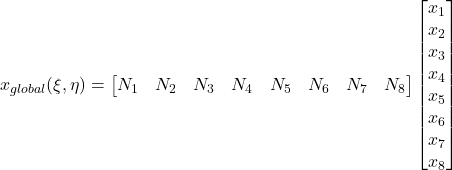
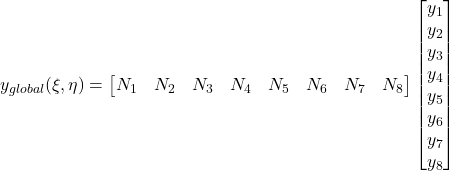
Jacobian Matrix
 =\renewcommand*{\arraystretch}{2.5}\begin{bmatrix}\cfrac{\partial x}{\partial \xi} & \cfrac{\partial x}{\partial \eta} \\\cfrac{\partial y}{\partial \xi} & \cfrac{\partial y}{\partial \eta}\end{bmatrix}](https://modearchitecture.com/wp-content/ql-cache/quicklatex.com-422fff329b7371f7285905a075d14ad3_l3.png "Rendered by QuickLaTeX.com")
Where:
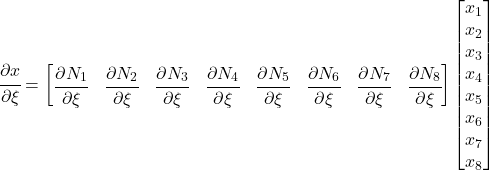
The partial derivative for y and partial derivatives with respect to  are identical to the above: just swap out the relevant symbols.
Making use of the ![[\partial N]](https://modearchitecture.com/wp-content/ql-cache/quicklatex.com-c4d170532b2cb4994f64bf94daca96ca_l3.png "Rendered by QuickLaTeX.com") matrix, presented below, the Jacobian matrix can be expressed as follows:
matrix, presented below, the Jacobian matrix can be expressed as follows:
 = [\partial N](\xi, \eta)\begin{bmatrix}x_1 & y_1 \\x_2 & y_2 \\x_3 & y_3 \\x_4 & y_4 \\x_5 & y_5 \\x_6 & y_6 \\x_7 & y_7 \\x_8 & y_8 \end{bmatrix}](https://modearchitecture.com/wp-content/ql-cache/quicklatex.com-26cb055b4ec1c00d7b482d899568d0d3_l3.png "Rendered by QuickLaTeX.com")
 N Matrix
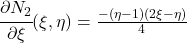
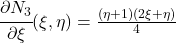
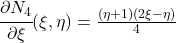
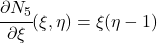
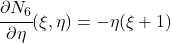
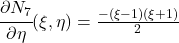
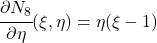
To simplify further calculations, we can define a N matrix as follows:
 =\renewcommand*{\arraystretch}{2.5}\begin{bmatrix}\cfrac{\partial N_1}{\partial \xi} & \cfrac{\partial N_2}{\partial \xi} & \cfrac{\partial N_3}{\partial \xi} & \cfrac{\partial N_4}{\partial \xi} & \cfrac{\partial N_5}{\partial \xi} & \cfrac{\partial N_6}{\partial \xi} & \cfrac{\partial N_7}{\partial \xi} & \cfrac{\partial N_8}{\partial \xi} \\\cfrac{\partial N_1}{\partial \eta} & \cfrac{\partial N_2}{\partial \eta} & \cfrac{\partial N_3}{\partial \eta} & \cfrac{\partial N_4}{\partial \eta} & \cfrac{\partial N_5}{\partial \eta} & \cfrac{\partial N_6}{\partial \eta} & \cfrac{\partial N_7}{\partial \eta} & \cfrac{\partial N_8}{\partial \eta}\end{bmatrix}](https://modearchitecture.com/wp-content/ql-cache/quicklatex.com-800e43fb1ab73787660262d17f36365f_l3.png "Rendered by QuickLaTeX.com")
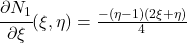
Where:
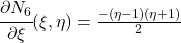
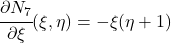
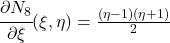
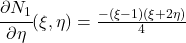
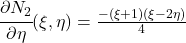
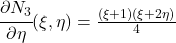
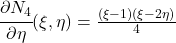
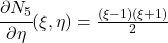
B Matrix Derivation
 =\begin{bmatrix}\epsilon_{xx} \\\epsilon_{yy} \\\gamma_{xy}\end{bmatrix} =\begin{bmatrix}\epsilon_{xx} \\\epsilon_{yy} \\\epsilon_{xy} + \epsilon_{yx} \\\end{bmatrix} =\renewcommand*{\arraystretch}{2.5}\begin{bmatrix}\cfrac{du}{dx} \\\cfrac{dv}{dy} \\\cfrac{du}{dy} + \cfrac{dv}{dx} \\\end{bmatrix} =\renewcommand*{\arraystretch}{1.0}\begin{bmatrix}1 & 0 & 0 & 0 \\0 & 0 & 0 & 1 \\0 & 1 & 1 & 0\end{bmatrix}\renewcommand*{\arraystretch}{2.5}\begin{bmatrix}\cfrac{du}{dx} \\\cfrac{du}{dy} \\\cfrac{dv}{dx} \\\cfrac{dv}{dy}\end{bmatrix}](https://modearchitecture.com/wp-content/ql-cache/quicklatex.com-ad4a3c4df44be0c2325e571249546e49_l3.png "Rendered by QuickLaTeX.com")
Where (by multivariable chain rule):
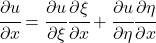
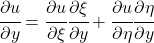
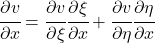
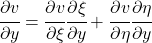
Or, in matrix form:
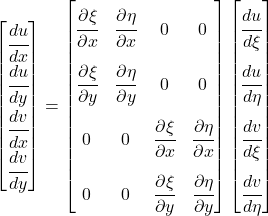
Conveniently, the first matrix can be simplified based on existing information, because:
^{-1})^T](https://modearchitecture.com/wp-content/ql-cache/quicklatex.com-24a55d466a4b3a7d5f0f3490dd45396e_l3.png "Rendered by QuickLaTeX.com")
Because  and
and  are just the nodal displacements at
  and
and  , the same coordinate mapping applies here:
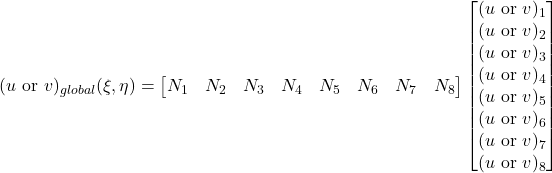
Therefore:

Replacing the nodal displacements with a vector, ![[u] =\begin{bmatrix}u_1 \\v_1 \\\vdots \\u_8 \\v_8 \\\end{bmatrix}](https://modearchitecture.com/wp-content/ql-cache/quicklatex.com-803c5bfaefbd29a50b40c33a58797627_l3.png "Rendered by QuickLaTeX.com") ,
,
![\renewcommand*{\arraystretch}{2.5}\begin{bmatrix}\cfrac{du}{d\xi} \\\cfrac{du}{d\eta} \\\cfrac{dv}{d\xi} \\\cfrac{dv}{d\eta}\end{bmatrix} = \renewcommand*{\arraystretch}{2.5}\setcounter{MaxMatrixCols}{20}\begin{bmatrix}\cfrac{\partial N_1}{\partial \xi} & 0 & \cfrac{\partial N_2}{\partial \xi} & 0 & \cfrac{\partial N_3}{\partial \xi} & 0 & \cfrac{\partial N_4}{\partial \xi} & 0 & \cfrac{\partial N_5}{\partial \xi} & 0 & \cfrac{\partial N_6}{\partial \xi} & 0 & \cfrac{\partial N_7}{\partial \xi} & 0 & \cfrac{\partial N_8}{\partial \xi} & 0 \\\cfrac{\partial N_1}{\partial \eta} & 0 & \cfrac{\partial N_2}{\partial \eta} & 0 & \cfrac{\partial N_3}{\partial \eta} & 0 & \cfrac{\partial N_4}{\partial \eta} & 0 & \cfrac{\partial N_5}{\partial \eta} & 0 & \cfrac{\partial N_6}{\partial \eta} & 0 & \cfrac{\partial N_7}{\partial \eta} & 0 & \cfrac{\partial N_8}{\partial \eta} & 0 \\0 & \cfrac{\partial N_1}{\partial \xi} & 0 & \cfrac{\partial N_2}{\partial \xi} & 0 & \cfrac{\partial N_3}{\partial \xi} & 0 & \cfrac{\partial N_4}{\partial \xi} & 0 & \cfrac{\partial N_5}{\partial \xi} & 0 & \cfrac{\partial N_6}{\partial \xi} & 0 & \cfrac{\partial N_7}{\partial \xi} & 0 & \cfrac{\partial N_8}{\partial \xi} \\0 & \cfrac{\partial N_1}{\partial \eta} & 0 & \cfrac{\partial N_2}{\partial \eta} & 0 & \cfrac{\partial N_3}{\partial \eta} & 0 & \cfrac{\partial N_4}{\partial \eta} & 0 & \cfrac{\partial N_5}{\partial \eta} & 0 & \cfrac{\partial N_6}{\partial \eta} & 0 & \cfrac{\partial N_7}{\partial \eta} & 0 & \cfrac{\partial N_8}{\partial \eta}\end{bmatrix}[u]](https://modearchitecture.com/wp-content/ql-cache/quicklatex.com-90aa9a19c9fdecfde2c7beace4d2768f_l3.png "Rendered by QuickLaTeX.com")
This 4×16 matrix is just the matrix with zero columns inserted between each column, repeated and offset by one column. Therefore, let us define:
![[\partial N2] \equiv\renewcommand*{\arraystretch}{2.5}\setcounter{MaxMatrixCols}{20}\begin{bmatrix}\cfrac{\partial N_1}{\partial \xi} & 0 & \cfrac{\partial N_2}{\partial \xi} & 0 & \cfrac{\partial N_3}{\partial \xi} & 0 & \cfrac{\partial N_4}{\partial \xi} & 0 & \cfrac{\partial N_5}{\partial \xi} & 0 & \cfrac{\partial N_6}{\partial \xi} & 0 & \cfrac{\partial N_7}{\partial \xi} & 0 & \cfrac{\partial N_8}{\partial \xi} & 0 \\\cfrac{\partial N_1}{\partial \eta} & 0 & \cfrac{\partial N_2}{\partial \eta} & 0 & \cfrac{\partial N_3}{\partial \eta} & 0 & \cfrac{\partial N_4}{\partial \eta} & 0 & \cfrac{\partial N_5}{\partial \eta} & 0 & \cfrac{\partial N_6}{\partial \eta} & 0 & \cfrac{\partial N_7}{\partial \eta} & 0 & \cfrac{\partial N_8}{\partial \eta} & 0 \\0 & \cfrac{\partial N_1}{\partial \xi} & 0 & \cfrac{\partial N_2}{\partial \xi} & 0 & \cfrac{\partial N_3}{\partial \xi} & 0 & \cfrac{\partial N_4}{\partial \xi} & 0 & \cfrac{\partial N_5}{\partial \xi} & 0 & \cfrac{\partial N_6}{\partial \xi} & 0 & \cfrac{\partial N_7}{\partial \xi} & 0 & \cfrac{\partial N_8}{\partial \xi} \\0 & \cfrac{\partial N_1}{\partial \eta} & 0 & \cfrac{\partial N_2}{\partial \eta} & 0 & \cfrac{\partial N_3}{\partial \eta} & 0 & \cfrac{\partial N_4}{\partial \eta} & 0 & \cfrac{\partial N_5}{\partial \eta} & 0 & \cfrac{\partial N_6}{\partial \eta} & 0 & \cfrac{\partial N_7}{\partial \eta} & 0 & \cfrac{\partial N_8}{\partial \eta}\end{bmatrix}](https://modearchitecture.com/wp-content/ql-cache/quicklatex.com-2990f94f62fbd59110d5327d39a2145f_l3.png "Rendered by QuickLaTeX.com")
Putting all the pieces together gives
 =\begin{bmatrix}1 & 0 & 0 & 0 \\0 & 0 & 0 & 1 \\0 & 1 & 1 & 0\end{bmatrix}\begin{bmatrix}([J](\xi, \eta)^{-1})^T & \begin{bmatrix}0 & 0 \\0 & 0\end{bmatrix} \\\begin{bmatrix}0 & 0 \\0 & 0\end{bmatrix} & ([J](\xi, \eta)^{-1})^T\end{bmatrix}[\partial N2]](https://modearchitecture.com/wp-content/ql-cache/quicklatex.com-a21a045b3562bb66b66eefb8721cf714_l3.png "Rendered by QuickLaTeX.com")
By the definition of the kinematic matrix (![[B]](https://modearchitecture.com/wp-content/ql-cache/quicklatex.com-d8908cd587f5e0160dcddfba1d4b56a4_l3.png "Rendered by QuickLaTeX.com") )
)
 = [B](\xi,\eta)[u]](https://modearchitecture.com/wp-content/ql-cache/quicklatex.com-b395dbd53604e0920a929bc5de649761_l3.png "Rendered by QuickLaTeX.com")
Which implies
 =\begin{bmatrix}1 & 0 & 0 & 0 \\0 & 0 & 0 & 1 \\0 & 1 & 1 & 0\end{bmatrix}\begin{bmatrix}([J](\xi, \eta)^{-1})^T & \begin{bmatrix}0 & 0 \\0 & 0\end{bmatrix} \\\begin{bmatrix}0 & 0 \\0 & 0\end{bmatrix} & ([J](\xi, \eta)^{-1})^T\end{bmatrix}[\partial N2]](https://modearchitecture.com/wp-content/ql-cache/quicklatex.com-660b4ff1d1eefe68db833712c76f0876_l3.png "Rendered by QuickLaTeX.com")
C Matrix
Under plane stress,
 =\begin{bmatrix}\sigma_{xx} \\\sigma_{yy} \\\tau_{xy}\end{bmatrix} =\cfrac{E}{1-\nu^2}\begin{bmatrix}1 & \nu & 0 \\\nu & 1 & 0 \\0 & 0 & 1-\nu\end{bmatrix}\begin{bmatrix}\epsilon_{xx} \\\epsilon_{yy} \\\epsilon_{xy}\end{bmatrix}](https://modearchitecture.com/wp-content/ql-cache/quicklatex.com-6b6c7fbbba6603b9eeb41b57fdee62ca_l3.png "Rendered by QuickLaTeX.com")
By the definition of the constitutive matrix (![[C]](https://modearchitecture.com/wp-content/ql-cache/quicklatex.com-c01dd89cf3e871779a9e1e59c15e2322_l3.png "Rendered by QuickLaTeX.com") ):
):
 = [C][\epsilon_{2D}](x,y)](https://modearchitecture.com/wp-content/ql-cache/quicklatex.com-caa9932658b76af74a514f146dc49dc0_l3.png "Rendered by QuickLaTeX.com")
Therefore,![[C] = \cfrac{E}{1-\nu^2}\begin{bmatrix}1 & \nu & 0 \\\nu & 1 & 0 \\0 & 0 & 1-\nu\end{bmatrix}](https://modearchitecture.com/wp-content/ql-cache/quicklatex.com-f2fa24f87692bed5b9b2d610b6b10f9a_l3.png "Rendered by QuickLaTeX.com")
Element Stiffness Matrix
![\[[k_e] = t\int_{-1}^{1}\int_{-1}^{1}[B](\xi,\eta)^T[C][B](\xi,\eta)\text{det}\bigl([J](\xi,\eta)\bigr) d\xi d\eta\]](https://modearchitecture.com/wp-content/ql-cache/quicklatex.com-7943b4f4d249d2c1b47e4137f8d3e216_l3.png "Rendered by QuickLaTeX.com")
This integral can be simplified by using Gauss Integration (recommended n=3 for balance between performance and accuracy – this requires sampling the element at 9 points)
Tutorial: Dr. Clayton Pettit on Gaussian Integration
Post Processing
Once nodal deflections ![[u]](https://modearchitecture.com/wp-content/ql-cache/quicklatex.com-45e5540ef480988a4011e8ca30c40b1e_l3.png "Rendered by QuickLaTeX.com") are known, the strains and stresses can be determined at any point on the element:
are known, the strains and stresses can be determined at any point on the element:
 =\begin{bmatrix}\epsilon_{xx} \\\epsilon_{yy} \\\gamma_{xy}\end{bmatrix} = [B](\xi,\eta)[u]](https://modearchitecture.com/wp-content/ql-cache/quicklatex.com-9af3440f22bb91a747f7b04b6783a0d2_l3.png "Rendered by QuickLaTeX.com")
 = \begin{bmatrix}\sigma_{xx} \\\sigma_{yy} \\\tau_{xy}\end{bmatrix} =[C][\epsilon_{2D}](x,y)](https://modearchitecture.com/wp-content/ql-cache/quicklatex.com-7c90b3f440880b740306ad1a05412e8f_l3.png "Rendered by QuickLaTeX.com")
![\begin{bmatrix}\sigma_{xx} \\\sigma_{yy} \\\tau_{xy}\end{bmatrix} = [C][B](\xi,\eta)[u]](https://modearchitecture.com/wp-content/ql-cache/quicklatex.com-1899b7842fd7e23a27e8c85dfadd1678_l3.png "Rendered by QuickLaTeX.com")
Note that it is not easy to convert from the local/global coordinate systems to the natural coordinate system. Because all of the shape functions depend on inputs of  and , working backwards requires a trial and error process until the
  guesses match the desired x, y outputs.
Therefore, it is more typical to calculate stresses in the natural coordinate system at regular intervals and place these at their corresponding places in the local coordinate system.